Most systems were never designed
The systems that shape your work, your business, and your industry mostly accumulated by accident. That's not a flaw in the people using them — it's the design opportunity of our generation.
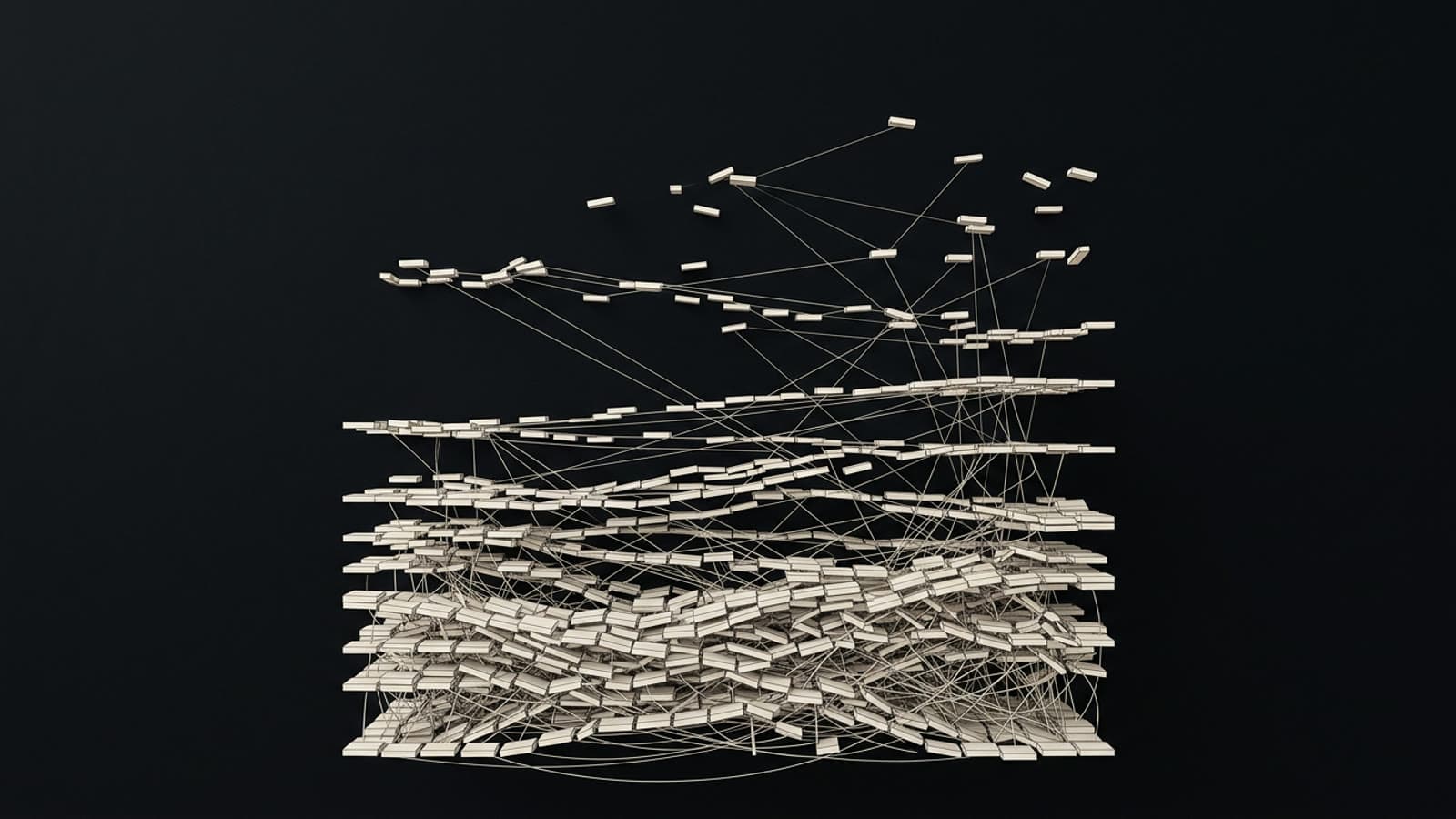
Look closely at any process that frustrates you — registering a business, getting paid for what you know, promoting work you're proud of — and you'll find the same thing underneath: a system nobody actually designed.
It evolved. A rule was added to patch a problem. A form was added to satisfy the rule. A workaround was invented to survive the form. Decades later, the workaround is the system, and everyone inside it assumes this is simply how things are.
Complexity is accumulated, not inherent
Most complexity in daily economic life is not essential to the problem being solved. It's sediment — layers of decisions that made sense once, in a context that no longer exists.
This matters because of what it implies. If complexity were inherent, the only option would be to endure it. But if complexity is accumulated, it can be removed — by someone willing to go back to the original question and ask how it would be solved today, with modern tools available from the start.
That question is where every one of our projects begins.
People are rarely the limit
When a business fails, we tend to audit the people. Did they work hard enough? Were they smart enough? Did they want it enough?
Ask a different question: what systems were they operating inside? A capable person inside a badly designed system produces bad outcomes, reliably. The reverse is also true — ordinary effort inside a well-designed system compounds.
People are rarely limited by their potential. They are limited by the systems surrounding them.
This is not an excuse for the people. It's an indictment of the systems — and an invitation.
Digitizing a broken system preserves it
The last two decades of software mostly did one thing: it moved existing processes onto screens. The paperwork became web forms. The filing cabinet became a database. The queue became a ticket number.
That's digitization, and it has real value. But it also has a hidden cost: once a broken process is digitized, it hardens. The software becomes one more layer of sediment defending the design underneath.
Redesign is different. It asks whether the process should exist in its current shape at all. It treats technology — including artificial intelligence — as the implementation layer of a better system, not as a coat of paint on the old one.
The test
Here is a simple test for any tool you're evaluating, including ours: after using it, do you understand your situation better, with fewer decisions left on your plate? Or are you now managing the tool on top of everything else?
Systems that pass this test absorb complexity. Systems that fail it redistribute complexity onto you.
Better systems create better outcomes. The systems most people operate inside were never designed to create good outcomes — they weren't designed at all. That's not a reason for cynicism. It's the clearest opportunity we can see.