

10 Best Online Payment Systems for Small Businesses
Essentials • 2026 04 27 • 8 min read

For small businesses, the right payment system does more than process transactions. It shapes customer trust, affects conversion rates, and determines how smoothly your business can scale. Research consistently shows that checkout friction is one of the biggest reasons customers abandon a purchase, which makes payment infrastructure a branding decision as much as an operational one.
If you are building a modern digital presence, your payment tools should fit your website, your content, and your workflows. The best platforms help you get paid faster, automate follow up tasks, and create a more polished customer experience across every touchpoint.
Why payment systems matter more than ever
Online payment systems sit at the center of digital identity. A clunky checkout flow can make even a great brand feel unreliable, while a fast and intuitive payment experience can improve trust instantly.
For small businesses and creators, the ideal platform usually needs to do four things well:
- Accept payments quickly and securely
- Work with your website, store, or booking flow
- Support automation, receipts, subscriptions, and follow up actions
- Match the customer experience your brand promises
In practical terms, this means choosing a platform that fits not just your budget, but your workflow and growth strategy.
What to evaluate before you choose
Before comparing providers, define how your business gets paid. Some businesses need one time checkouts, others need invoices, subscriptions, memberships, or mobile tap to pay options.
Core decision factors
- Transaction fees: Look at standard card rates, international fees, chargeback costs, and payout timing.
- Ease of setup: No code integrations can save hours if you are using platforms like Webflow, Shopify, Notion, Airtable, or Zapier.
- Brand control: Branded checkout pages and embedded forms create a more consistent customer journey.
- Automation: The best tools trigger receipts, CRM updates, onboarding emails, and fulfillment workflows automatically.
- Scalability: Your payment system should grow with your offers, not force a rebuild six months later.
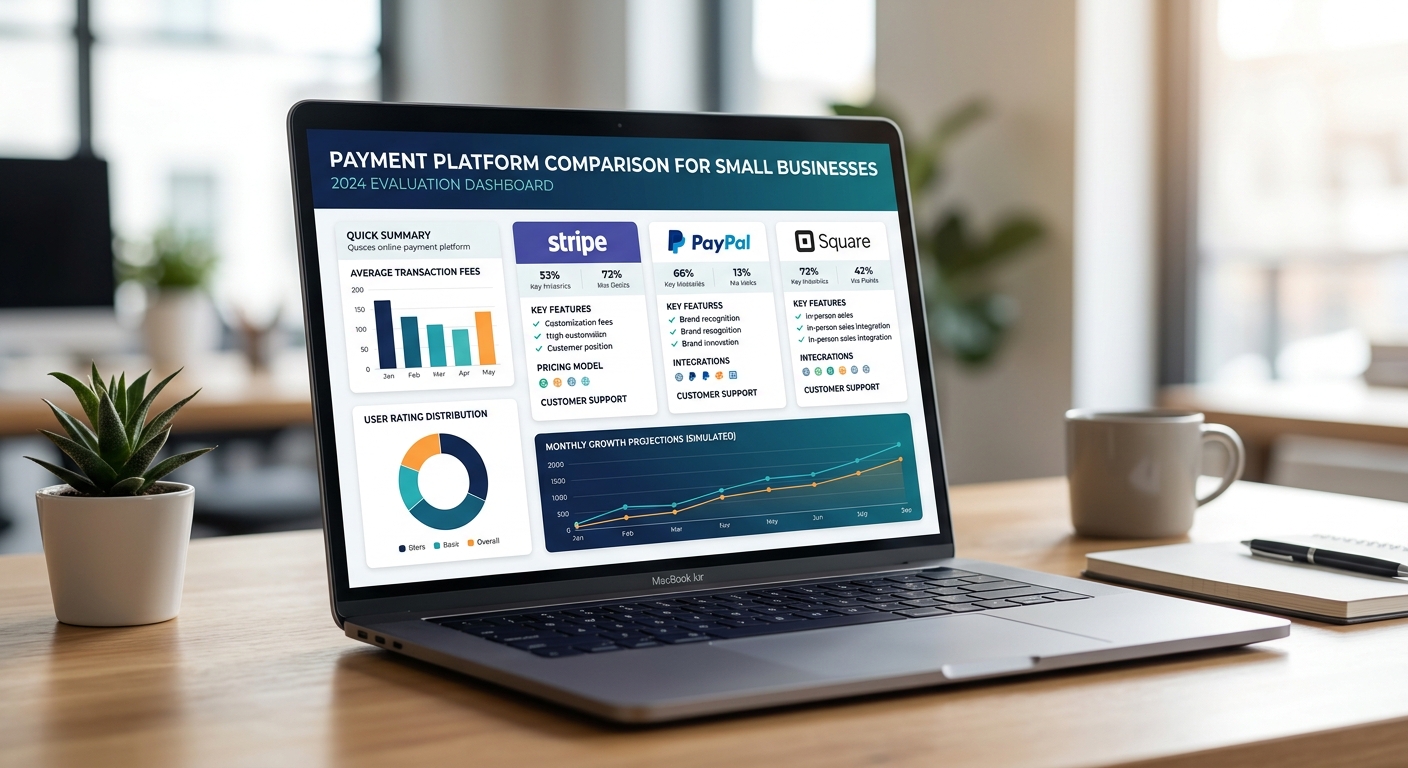
Image caption: A simple comparison dashboard showing payment fees, integrations, and automation features for a growing small business.

Quick comparison table
| Platform | Best For | Standout Strength |
|---|---|---|
| Stripe | Custom websites and automation | Developer friendly and flexible APIs |
| PayPal | Trust and broad consumer familiarity | Fast recognition at checkout |
| Square | Retail plus online sales | Strong omnichannel tools |
| Shopify Payments | Ecommerce brands | Native store integration |
| Helcim | Cost conscious businesses | Transparent interchange plus pricing |
| Wise Business | International payments | Competitive cross border transfers |
| Authorize.Net | Established merchants | Long standing gateway reliability |
| QuickBooks Payments | Service businesses | Accounting integration |
| Paddle | Digital products and SaaS | Merchant of record model |
| Gumroad | Creators and simple digital selling | Fast launch for solo sellers |
1. Stripe
Stripe remains one of the strongest options for modern small businesses, especially if you want flexibility. It supports one time payments, subscriptions, payment links, invoices, embedded checkout, and deep automation through APIs and no code tools.
It is especially useful for businesses that want payments to feel native to their brand, not bolted on afterward.
- Best for: Service businesses, SaaS, digital products, custom websites
- Why it stands out: Excellent integrations with Webflow, Zapier, Airtable, and custom workflows
- Watch for: Advanced features can feel overwhelming if you want a plug and play setup only
2. PayPal
PayPal still carries strong consumer trust, which can help increase checkout confidence, especially with first time buyers. It is widely recognized, easy to add, and useful for businesses that sell both domestically and internationally.
- Best for: Small businesses that want a familiar and fast start payment option
- Why it stands out: Strong brand recognition and broad customer adoption
- Watch for: The customer experience can feel less branded compared to more customizable systems
3. Square
Square is ideal for businesses that sell both online and in person. If you operate a retail shop, pop up, studio, cafe, or appointment based business, Square creates a unified system across point of sale, inventory, invoicing, and online checkout.
- Best for: Brick and mortar businesses with an online presence
- Why it stands out: Smooth omnichannel management
- Watch for: Less flexible than Stripe for heavily customized digital workflows
Image caption: A boutique owner using a tablet POS while the same product catalog updates online in real time.
4. Shopify Payments
If your business runs on Shopify, Shopify Payments is often the simplest choice. It reduces the need for third party complexity and keeps checkout, order management, and reporting inside one system.
- Best for: Ecommerce first brands
- Why it stands out: Native integration and less setup friction
- Watch for: Best value comes when Shopify is already central to your business stack
5. Helcim
Helcim is a smart option for businesses looking for transparent pricing. Its interchange plus model can be more cost effective than flat rate platforms for some merchants, especially as transaction volume grows.
- Best for: Businesses focused on reducing payment processing costs
- Why it stands out: Clear fee structure and strong value for scaling merchants
- Watch for: It may not have the same ecosystem recognition as Stripe or PayPal
6. Wise Business
Wise Business is not a full traditional checkout platform in the same way as Stripe or Square, but it is excellent for international payments. For service providers, agencies, and global creators, it can lower the cost and friction of getting paid across borders.
- Best for: International invoices and cross border payments
- Why it stands out: Better exchange rate transparency than many traditional providers
- Watch for: Not a complete ecommerce checkout solution for every use case
7. Authorize.Net
Authorize.Net is a long established payment gateway used by many businesses that want stable, traditional infrastructure. It can be a strong fit for merchants with more established operations or existing merchant account relationships.
- Best for: Businesses that need a proven gateway with broad compatibility
- Why it stands out: Reliability and long term market presence
- Watch for: Setup can feel less modern than newer all in one platforms
8. QuickBooks Payments
QuickBooks Payments is especially useful for service businesses already managing invoicing and accounting inside QuickBooks. It streamlines bookkeeping and makes it easier to connect payments directly to financial records.
- Best for: Consultants, agencies, and local service businesses
- Why it stands out: Tight accounting integration
- Watch for: Less ideal for highly customized branded checkout experiences
9. Paddle
Paddle is built with software companies and digital product sellers in mind. Its merchant of record model can simplify taxes, compliance, and billing complexity, which is a major advantage for online first businesses with global customers.
- Best for: SaaS, software, and digital subscriptions
- Why it stands out: Compliance and tax handling for digital sales
- Watch for: More specialized than a general purpose checkout tool
10. Gumroad
Gumroad is one of the easiest ways for creators to start selling digital products, memberships, and simple offers. It is not the most customizable option, but it is fast, accessible, and practical for solo businesses that need to validate an offer quickly.
- Best for: Creators, educators, writers, and solo digital sellers
- Why it stands out: Very fast launch with minimal setup
- Watch for: Limited control over the full brand and checkout experience
How automation turns payments into growth
A payment platform should not stop at collecting money. The real value appears when that transaction triggers the rest of your business system automatically.
For example, one purchase can instantly:
- Send a branded confirmation email
- Create or update a CRM contact
- Deliver a product or access link
- Schedule onboarding steps
- Start an upsell or nurture sequence
This is where AI and no code automation become powerful. Instead of treating payments as a separate task, small businesses can connect them to content delivery, customer management, and retention workflows.
Recommended picks by business type
If you want a quick starting point, use this guide:
| Business Type | Recommended Platform |
|---|---|
| Custom service business website | Stripe |
| Local retail plus online store | Square |
| Shopify ecommerce brand | Shopify Payments |
| Creator selling digital downloads | Gumroad |
| SaaS or subscription product | Paddle or Stripe |
| Global consulting or freelance business | Wise Business |
| Accounting led service firm | QuickBooks Payments |
The best choice depends on how much control, automation, and brand consistency you want across your digital presence.
Tools and Resources
- Stripe: Great for branded payments, subscriptions, and automation
- Square: Strong for in person and online sales together
- Shopify Payments: Best for businesses already built on Shopify
- Zapier or Make: Connect payment events to CRM, email, and fulfillment workflows
- Airtable: Organize customer data and transaction based automations
- Webflow: Create a more polished branded front end for checkout journeys
Key Takeaways
- The best payment system supports both transactions and brand trust.
- Stripe is the most flexible choice for custom websites and automation driven workflows.
- Square and Shopify Payments are strong options when commerce happens inside a larger platform ecosystem.
- Creators and digital sellers should prioritize speed, subscriptions, and delivery automation.
- A smart payment setup turns every purchase into a seamless customer journey.
Quick Stats
| Label | Value |
|---|---|
| Cart abandonment often linked to checkout friction | 70%+ |
| Consumers who value fast, simple checkout | High majority |
| Time saved with automated payment workflows | Hours per week |
Conclusion
Choosing an online payment system is really about choosing how your business feels to customers, and how efficiently it runs behind the scenes. The right platform should help you get paid, reinforce your brand, and connect cleanly to the systems that support long term growth. At Domain DESGNR, we help small businesses and creators build that full digital infrastructure, combining strong brand identity, AI powered workflows, and no code automation into payment experiences that feel seamless from first click to final conversion.
Tags: paymentsbrandingdigital identityautomation
